



5
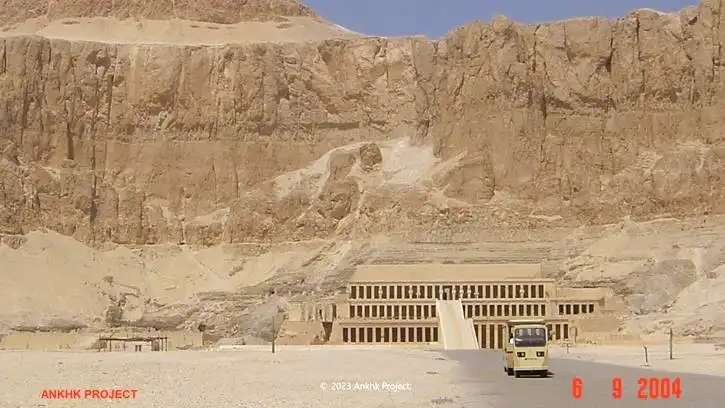
At the Temple of Hatshepsut...
The first woman to become Pharaoh of the Eighteenth (18th) Dynasty of Egypt. Yes, we decided to simply lose ourselves in the grandeur of that temple, without the need to search for something directly related to our "first observation" or our "codes". After all, we were there to experience it, to appreciate every detail of that place, and not to stay caught up in the constant search that was beginning to leave us a little tired, which, in a way, was affecting the genuine enjoyment of the visit.
Therefore, we decided to apply this same procedure to the Luxor Complex, including Karnak. And what was becoming more of an exploration than a fun activity would now return to its original point.
However, as is often the case in our daily lives, the unexpected always happens... and given everything that had already occurred on this trip, this certainly wouldn’t be a rare exception! It didn’t take long before we were once again pulled into our new journey of discoveries, as we came across something surprising in this temple.
We mention "new" because, in addition to the unequivocal confirmation that something much larger was at play, with everything being passed down from "generation to generation," we also had the absolute certainty that what we found in Abu Simbel was definitely a "complex algorithm," still in formation. Therefore, in the next stage of our journey, we will dive deeper into this new discovery, which will certainly take us to a new level of understanding, once again placing us on the road of our already exhausting, but fascinating, search.
Photo credit: Our records - Hatshepsut Temple - Luxor (Deir el-Bahari) - Egypt - 2004.
References: Hatshepsut (Tyldesley, Joyce. "Hatshepsut".
Encyclopedia Britannica, 23 Jun. 2023, https://www.britannica.com/biography/Hatshepsut. Accessed 24 June 2023.) /
Hatshepsut Temple (Mark, Joshua J..
"The Temple of Hatshepsut." World History Encyclopedia. World History Encyclopedia, 18 Jul 2017. Web. 24 Jun 2023.).
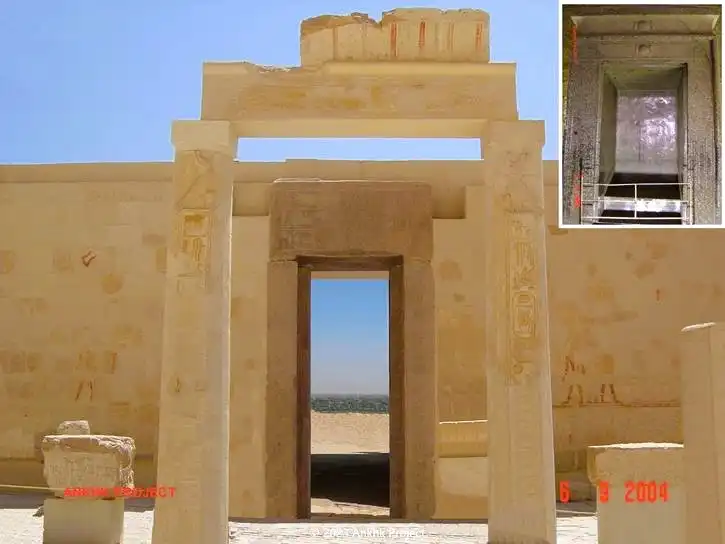
So... when we were walking through this temple, carefully observing everything around us, even without the need to find something, yes, we once again realized that we might be facing a new and important clue. The most interesting part is that, at the Temple of Edfu, we went through the same situation, where we encountered the same clue. However, there, unlike in this Temple of Hatshepsut, we simply took a photo (a small photo in the upper-right corner... observe) and moved on, without realizing the exact connection that was now before us.
OK... so, what made us change our minds and add this new code?
The answer is simple... just one feeling, something that occurred to us now, but not in Edfu!
Something internally told us that this was not just a new code, but something very important! Even though it didn’t "visually" match everything we had recognized up until that moment. However, we had a clear sense that we would need this "code" throughout our journey! So, without hesitation, we took the photo and quickly added it to our list of codes. Therefore, this would be our fifth (5th) code, even though we still didn’t know which "scenario" it would fit into, as it was quite different from everything we had been finding.
Now, about this new code in this image... OK, it might be a little hard to visualize. Anyway, we will show it more closely in the next step. But observe, this time we will present clearly its identification: it is the set of wings with serpents, seen around the central circle, right at the top of the column. And notice that, in the photo taken at the Temple of Edfu (Sanctuary of Horus), this code is much more evident, with two (2) sets in the center, at the top, one below the other.
Photo credit: Our records - Hatshepsut Temple - Luxor (Deir el-Bahari) - Egypt - 2004. / Small Photo credit: Our records - Edfu Temple - Edfu (Sanctuary of Horus) - Egypt - 2004.
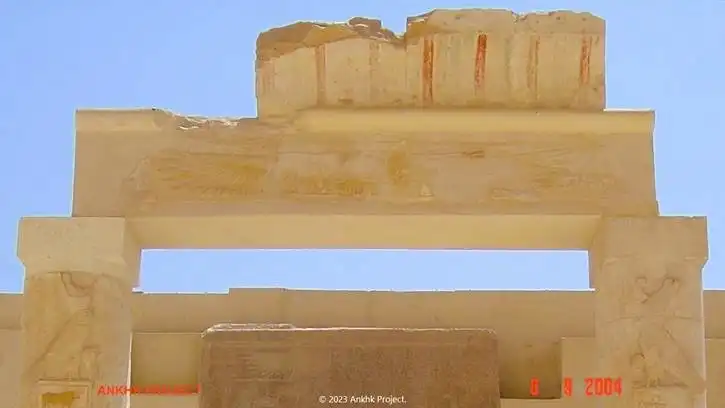
Not much better, but it was the best we could do regarding the photo!
However... believe us, looking at this code up close will not bring you anything substantial other than our previously made description. Because nothing that came to our hands too easily was necessarily simple to understand. Just like it is now for you, and as it certainly was for us during most of our research work.
Yes, we mentioned "easily" because it was the result of an "inner feeling" that we decided to accept and believe as true, and not from countless observations and analyses we tried to carry out at each location in our search for new clues and answers.
Very well, as always, now comes the crucial question...
And what could this set of wings with serpents, with the circle in the center, have to do with the Ankh symbol, which has been the focus of our perceptions up until now?
Well, what we can answer for now is that... definitely everything! But this time, we ourselves only understood, not nine (9) years later, but eleven (11) years later, two (2) years after finding the answer to the "complex algorithm" we had identified in Abu Simbel. Yes, it took a long time for us to understand that simple feeling that led us to include this set as a belonging member to our codes, which in turn, made up the chain related to the algorithm. So, don't worry, we will explore these points more deeply in the upcoming stages!
Just a reminder... after the nine (9) years it took us to decode and understand the "algorithm," it took us another seven (7) years to obtain all the necessary revelations, evidence, and conclusions!
Photo credit: Our records - Hatshepsut Temple - Luxor (Deir el-Bahari) - Egypt - 2004.
Ok, from our "first observation" we already have:
And now...
So... let's go to the Complex of Luxor, where we have the Temples of Luxor and Karnak!
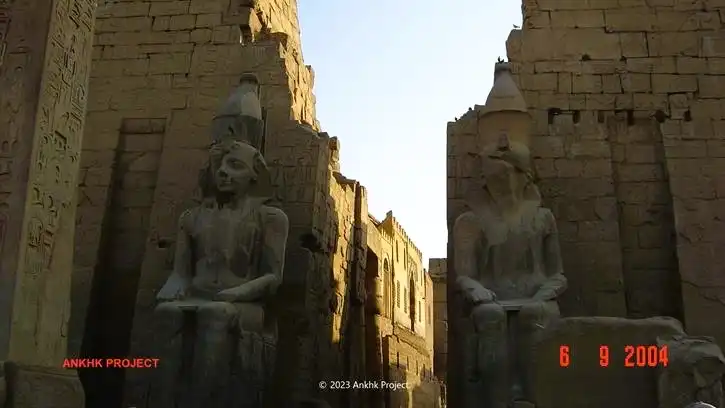
Very well, we were now at the Temple of Luxor, and we already had five (5) different codes in hand, or clues, if you prefer. These codes, without a doubt, connected as a "complex algorithm," where everything could be closely related to the "Ankh symbol".
However, let's observe a crucial point about this complex relationship...
OK, moving on... it was time to take a good look at that temple to see if we could find something new!
And... to our no surprise, nothing particularly new was found. However, we found four (4) of the five (5) codes already listed in various places. And one (1) of them, in particular, we noticed was more commonly found exclusively inside tombs. And more... the last code we added (the one with the wings) was also present there, but we generally found it above doors or portals, always "highlighted", above everything and everyone... really interesting!
So, with nothing new to reveal and with time running out, our next stop was the Temple of Karnak.
It is worth mentioning that... we know that this Egyptian symbol, and we are now talking about our code number 5, yes, most of the time, it should appear on doors and portals, always in a prominent position. Therefore, here, we are simply reinforcing what is already widely recognized by specialists. And believe us... our approach here has a good reason! Let's move forward!
Photo credit: Our records - Luxor Temple - Luxor - Egypt - 2004.
Reference: Luxor (Drower, Margaret Stefana. "Luxor". Encyclopedia Britannica,
26 Jan. 2023, https://www.britannica.com/place/Luxor. Accessed 28 June 2023.).
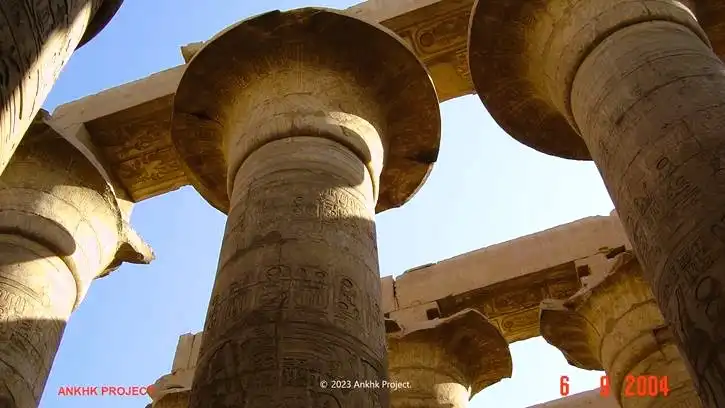
Yes, in Karnak, the situation repeated itself: we found our four (4) codes everywhere, and only one (1) of them, curiously, was very rare (as we already mentioned, this code is more commonly found in tombs). However, two (2) amazing events happened... one concerning Hatshepsut, and another about the Great Akhenaten. And this, without a doubt, would change the way we would perceive the rest of our journey.
Therefore, it is now crucial that you understand, one by one, and in detail, what really happened. And for that, let's begin with one of the most enigmatic and fascinating figures in the history of Egypt, the great Hatshepsut!
Photo credit: Our records - Karnak Temple - Luxor - Egypt - 2004.
References: Karnak (Drower, Margaret Stefana and Dorman, Peter F.. "Karnak".
Encyclopedia Britannica, 19 Nov. 2019, https://www.britannica.com/place/Karnak. Accessed 28 June 2023.) / Karnak
(Mark, Joshua J.. "Karnak." World History Encyclopedia. World History Encyclopedia, 16 Sep 2016. Web. 28 Jun 2023.).
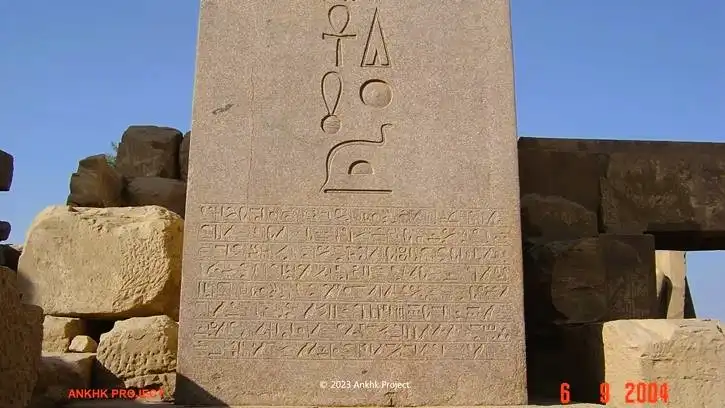
Now, let's return to the subject... and let's talk about Hatshepsut, through this obelisk that was erected in her name and is located at the Karnak Temple. So, let's analyze, in just three (3) stages, the hieroglyphs placed at its base (vertically), and we will do this in the same way we did on the day of our visit, thus aiming to present to everyone how we interpreted these inscriptions at that exact moment, and also what we had in mind, based on our innovative convictions:
Pay attention, we will be clearer... we are not referring to the complete message of this obelisk, but to the "final part", the part that, for sure, should express something grandiose about Hatshepsut, just as grandiose as the realization of this architectural masterpiece of such magnitude.
Therefore... with the inclusion of our new interpretation, this ending, which initially seemed simple and common for such an imposing obelisk, could now take on a much larger proportion, provided, of course, we could decode the "algorithm" found and started in Abu Simbel, giving meaning to what we saw in the hieroglyphs.
Now, just a break... yes, a short break to breathe and assimilate, because there was certainly a lot of information, and more will come below... so do not rush!
Let's continue...
And now, with our usual question... did you manage to understand what we are trying to explain? Notice that... understanding all this information above is of extreme and vital importance! Therefore, let’s try to clarify even further, not only the above scenario but the entire scenario so far involving this research! So, please, follow along with heightened attention...
Here we go...
Our "first important observation", led us to a different interpretation of the Ankh symbol... and up to here, yes, we thought everything was very clear! And with this, this symbol took on new and wide proportions...
well, we believe this part is also, without any doubt!
But on the other hand... pay close attention to what we are about to say... this same symbol, along with others that were present around it (our codes), meaning, inscriptions belonging to the same context (scenario), yes, they were forming a kind of set that, "together", could provide a complete meaning to our "new interpretation". In other words, this set, once recognized, could validate our "first important observation" in a clear and, most importantly, coherent manner!
So... did it make more sense now? We hope so, if not, re-read this section above if you need to, but mainly, continue below...
Therefore, this so-called "set", if it really existed, would take the form of an "algorithm", a fact we confirmed later, which was the reason for our subsequent searches. And this would mean that... if we couldn’t decipher it, or validate its true authenticity, our "new interpretation" of the Ankh symbol could indeed be completely invalidated, and, even the presumption that an algorithm existed from this symbol (our observation) would fall apart.
Now, is it clearer? Did you realize why we asked you to breathe just above? There is a lot of information, but everything revolves around the same axis, where we are simply looking for other clues to know if that set around the Ankh symbol could indeed be a complement to the symbol itself. And this would become essential, both to validate our "new interpretation", and to legitimize the hypothesis of the "algorithm", ultimately providing, if positive, a "new dimension" to the Ankh symbol in Egyptian history.
And finally, to conclude... this is what happened nine (9) years later, when we managed to decode this "complex algorithm". An algorithm that, at this point in our journey in Egypt, in front of the Hatshepsut obelisk, yes, already was a real fact of its existence, and we were simply complementing it with all the possible information while still being in Egyptian lands.
Phew... no one said it would be easy, "understandable", yes, but easy, no. And this applies both to you, trying to understand without us being able to present openly the facts, and to us, trying to convey something that cannot be easily explained in words, and even less in half words.
Well, in any case, the sequence of these steps (+ 41 steps) will reveal everything about this understanding, even though we are being "invited" to do so in this somewhat succinct and mysterious way. Otherwise, you certainly would not be having this opportunity available on the Internet (see Step 1 - "Before starting your journey").
Now, let's quickly talk about Akenathen, who brought us another important code, and this was the last one during our trip through Egypt.
Photo credit: Our records - Hatshepsut Obelisk (Karnak) - Luxor - Egypt - 2004.
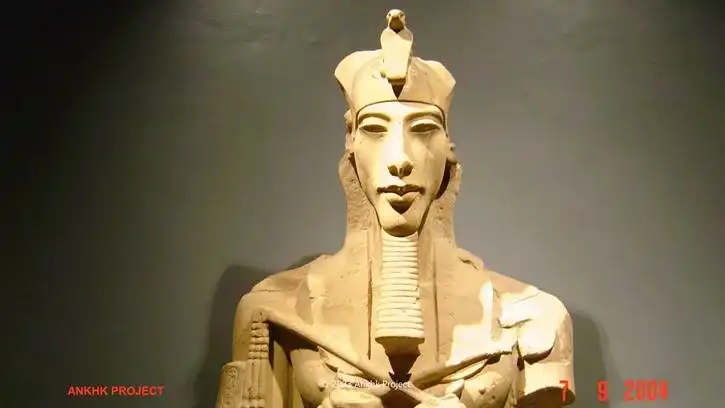
We haven’t mentioned it yet, but... especially in Luxor, just as now in Karnak...
As also happened in the Valley of the Kings, it was necessary to hire a local guide to assist us during our visits, considering the size of these places and the vast amount of information concentrated there. Thus, at a specific point inside Karnak, this guide, aiming to clarify what we were seeing in front of us, shared with us some particularities about Pharaoh Akhenaten* and that particular spot in the temple.
Initially, we listened attentively, absorbed the information, and continued with our visit. However, as we moved forward and recalled the topics discussed about Akhenaten, it was mentioned the religion he imposed on the population, the cult of the "one god", among other points. By the way, below we present two (2) links about Akhenaten, his life, and his religion. Continuing, we also remembered a fascinating image that depicted Akhenaten himself, his wife, his children, and the "one god" (the god Aten).
So, out of pure curiosity, we decided to quickly check through our papers, which always accompany us in our backpacks, to see if we could find it right then and there.
Well, we did not find exactly the image we had in mind, perhaps because we were not sure exactly where we had seen it. However, we found another, equally special, which depicted a very similar scene. And to our surprise... "Voilà!" This image revealed to us our sixth (6th) and final clue, which we will detail in our next step.
* (Photo of the bust of Akhenaten we took at the Luxor Museum. This photo already answers a possible question: yes, we did manage to find time to visit this magnificent museum. Luckily, we did!)
Photo credit: Our records - The Great Akhenaten (Luxor Museum) - Luxor - Egypt - 2004.
Reference: Akhenaten (Peter F. Dorman, Britannica, The Editors of Encyclopaedia "Akhenaten".
Encyclopedia Britannica, Jun 22, 2023, https://www.britannica.com/biography/Akhenaten. Accessed 28 June 2023.) /
Akhenaten (Mark, Joshua J.. "Akhenaten." World History Encyclopedia. World History Encyclopedia, 17 Apr 2014. Web. 28 Jun 2023.).
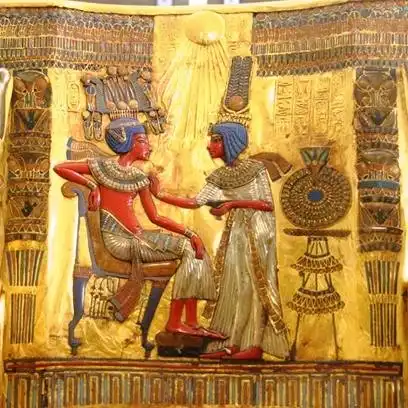
Yes, here is the image we found...
It comes from page 45 (image 50) of the photo book we bought inside the Cairo Museum, called 'Masterpieces of the Egyptian Museum of Cairo' (First Edition 2004 - Published by Farid Atiya Press). This is because photos were not allowed inside the museum at that time.
In this image, we primarily see King Tut and his wife, and of course, the god Aten (the only god mentioned by Akhenaten). And for those who "don't know" how to identify the god Aten... he is right above, in the center, represented by the circle (the solar disk) with rays coming out.
Therefore, if we look closer, we can notice that around it, some of our clues appear, as well as a new code that we promptly added to our list, the last one while we were still in Egypt.
And so, being very direct, as we still have much ahead: we have completed our rewarding and fantastic journey through Egyptian lands!
Photo credit: Djehouty, CC BY-SA 4.0, via Wikimedia Commons.
OK, after the Karnak Temple, we only had time to visit the Luxor Museum, then return to our ship, from where we went back to Cairo and, shortly after, left Egypt. However, our journey continued through Germany (Frankfurt), France (Paris), the USA (San Francisco), and after that, our return to Canada (Toronto), our final destination. Months later, more precisely in June 2005, we began our literary and technical research on what we had collected... photos, documents, notes, our already well-known six (6) codes, and, most importantly, our "algorithm" already formed and ready to be deciphered... if possible, of course!
So... nine (9) years later, already in Brazil for work, still trying to find a solution for the algorithm, in August 2013, we finally found our important answer. And... like a perfect "domino effect", we began to find several other possible answers to various mysteries in our history, which ended up transforming into an "avalanche of information".
Therefore, all these revelations, or at least an important part of them, we will present directly to you in the following of this Timeline.
So, we invite you to continue following this journey, which took us to so many other places, to personally verify our discoveries and, most importantly, collect important evidence!
We suggest that you take a short break before starting a new reading, re-read something if necessary, and only then, continue forward!
We are very grateful that you have made it this far!