



6
It was August 2013, now in Brazilian lands, a Saturday morning, just another day, nine (9) years since we started trying to decipher our codes, or, if you prefer, our "complex algorithm". And, as a result... still nothing!
It was like a complex equation, but missing one (1) or perhaps two (2) elements, which resulted in nothing that really made sense. Yes, much time had passed, several attempts, and nothing. We were almost giving up, leaving the past where it should be: in the past, when we couldn’t comprehend it! And this, is what we usually do!
However, there’s an old saying: If we are not able to understand our own past, what future can we have?! And that’s how, on that morning, we continued our usual research work.
And since progress hadn’t come for years, just to inform... we started dedicating only our free time to it. This meant weekends, holidays, and nighttime, when we were, obviously, physically able for this additional work journey. However, on this occasion, we still didn’t know, but this was about to change!
Well, as everything can truly be unpredictable, on that Saturday morning, which seemed like just another, something special happened! And, finally, we got our answers!
And how did we achieve this, if for nine (9) long years no path seemed plausible or coherent?
Well, here comes something we can’t explain, but many attribute to "chance", "fate", "coincidences", "luck", anyway, the name you want to give it. Because, suddenly, when we least expected it, reasoning and reflecting on something we had never thought about... an idea "clearly" emerged about a possible solution, and it might have been far from there...
It could only be there! Somewhere, but there! And, at that moment, we were not only geographically distant, but also in time! And this required thinking again "outside the box", just as we had done in front of the Ramses II Temple in Abu Simbel, when we made our "first important observation", which led us exactly to this point. Yes, because the tendency is always to be so focused on possible resolutions that, sometimes, we forget that the best approach might be, perhaps, "getting out of them", "stopping them", and simply "thinking about them" in a different way! And this, no, definitely does not concern chance!
However, now, to solve this problem, we only had our 1,200 photos and some forgotten papers, so... the best option was to review our records and try to find something there. Otherwise, we would have to return to that fabulous country, or maybe another nine (9) years would pass before we discovered our answers.
With few alternatives, but still with that "clear" feeling that our solution was still there, we began to search through everything that remained of those belongings. And that’s when a forgotten photo brought us a great insight!
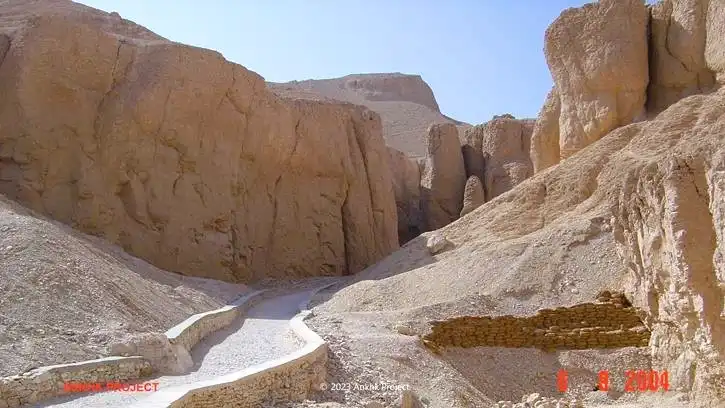
Now, let’s stop everything and take a good look at it... yes, this simple photo, where it seemed like we were taking a photo of "absolutely nothing", with rocks and a long path stretching to the middle of a "nowhere". However, believe it or not, at that location, right at the end, there’s a very special tomb!
Alright, let’s take a short pause in this sequence, because, given what has been presented about the photo, we need to explain another one of our many curious facts... so, let’s go!
However, after all this detailing above, there’s still one question left... but what about this other "inner feeling" this Saturday morning, that led us to find "our answers", can we put it in the same "account" above? Alright, let’s go, this one’s easy to answer... definitely yes! Why not? Because, without this absolute certainty, we obviously wouldn’t have revisited for the 108th time our collection of 1,200 photos, one by one, memory by memory, detail by detail, and for hours.
That said, the time has come to take a closer look at this path to the tomb, so let’s move straight to the next step...
Photo credit: Our records - Tomb's Long Path (King's Valley) - Luxor - Egypt - 2004.
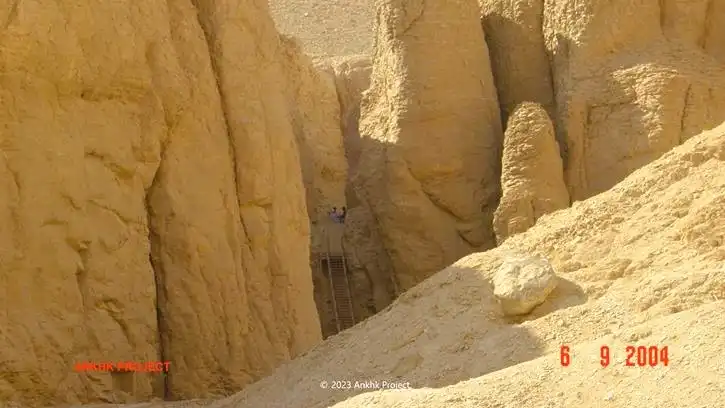
Well, up there, where those people are still working on its entrance, lies the final path to the tomb, carefully hidden and inaccessible to visitors at that time.
Now, let’s try to think the same way we did that morning when, after hours revisiting our collection of 1,200 photos, night had already fallen... we needed to find an answer for our algorithm, and we were firmly convinced that our answer was still there. We remembered the feeling of something "internal" guiding us to take those two (2) photos in the Valley of the Kings, and, by simple deduction, it was precisely that the key that led us to separate these images. So, we made the most sensible decision... search the internet for information about what might be inside that location, which had been the focus of all those unexpected movements, without any plausible explanation at the time, other than, of course, our "internal feeling".
Just for clarification, that tomb is KV 34, Tomb of Tuthmosis III, the 6th Pharaoh of Egypt, who reigned during the Eighteenth (18th) Dynasty (1458 - 1425 BCE). His tomb was found still incomplete. (as is well-known, see the link at the end of this step)
Well, after a few hours of research, we found an important document*, now available online in the collection of the Metropolitan Museum of Art in New York. And with this document, we found our seventh (7th) code, another important clue for our list.
However, with this new discovery, an important code, after nine (9) years, and even though we weren't physically in Egypt, we had both a great achievement and the recognition of a new challenge, that is, here we have the inevitable... the best and the worst part of this new conquest...
Yes, as for that, we had no alternatives, and to us, it was very clear!
On the other hand, we were now dealing with millennia of history, and obtaining the evidence needed might have been even more difficult than the nine (9) years we spent solving the algorithm, which almost brought us back to the starting point.
Decisively, nothing could be so simple that it couldn't become complicated in seconds! Solution? Move forward, both that day and now to our next step!
* The tomb of three foreign wives of Tuthmosis III (Lilyquist, Christine, with contributions by James E. Hoch and A. J. Peden - 2003, Publication - New York: The Metropolitan Museum of Art; New Haven; London: Yale University Press, c2003.).
Photo credit: Our records - Tuthmosis III Path (King's Valley) - Luxor - Egypt - 2004.
Reference: Tuthmosis III ((Mark, Joshua J.. "Thutmose III." World History Encyclopedia.
World History Encyclopedia, 20 Jul 2017. Web. 29 Jun 2023.).
Despite our new problems... it was time to check what we had so far!
Now, we had seven (7) important codes:
Adding to these, several other locations from our 2004 trip that repeatedly provided us with the same codes, such as: Kom-Ombo, Edfu, Luxor, Karnak, and the Obelisk of Hatshepsut. However... we still needed to find one or more concrete pieces of evidence!
Therefore, after so many years, this certainly wasn't the time to give up. And despite the challenges, pay close attention to the upcoming events...
When we found the seventh (7th) code (previous step), we said... "It gave us more than just a new clue, it also provided us with a new direction, a perspective, a true north to follow!".
Well, following this new direction, days later, we returned to the distant past of ancient Egypt, supposedly* during the time of King Menes or Narmer, as he is also known, and there we found our much-needed evidence, the element we needed to ensure the accuracy of our solution to the algorithm, exactly the key piece to complete that complicated equation, nine (9) long years later.
** Supposedly because the date associated with the evidence we found is not absolutely precise, it is only approximate, certainly considering its great antiquity and the conditions under which it was found. However, it perfectly corresponds with the period of Narmer's reign.
Now, let's check this evidence!
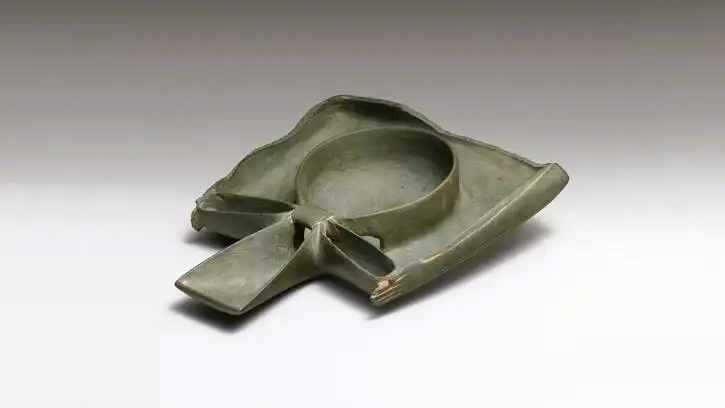
Yes, here it is!
And... if you were expecting a spectacular piece of evidence, we apologize, because, in fact, this is our real world. Here, presenting evidence like this, so ancient, so significant, and so well-preserved, is truly a reason to celebrate. After all, a simple vessel like this has the power to transform many things!
This is just one of the many reasons why archaeology is so fascinating: it has the power to reveal great mysteries and secrets with just one simple move.
And this is where this modest ritual vessel (3100 - 2900 BCE - early dynastic period) comes into play, with the power to change everything... probably (as we explained earlier), it dates back to the times of Narmer (2925 BCE), and is completely connected to the "Ankh symbol", as it is, in fact, the very shape of that symbol.
Therefore, whoever created this ritual vessel didn’t do so just to present us with a piece of art or a useful item for ceremonies. In reality, this person wanted to show us what was to come, not just years later, but for thousands of years, surely, even up to our present day!
And the best part comes now... because by truly believing in this, that the past, in some way, already anticipates the future...
Now, let's move forward and discover how this entire process unfolded!
And, to conclude, we apologize once again (and this will be the last time) for not being able to openly reveal all the details in this work. Otherwise, you wouldn't be having this opportunity, believe us! However, nothing prevents us from sharing, step by step, word by word, image by image, all the possible context. And that, in a way, is what comforts us... because many, for sure, with this work, will reach the discernment necessary to understand many things, truly uncover several secrets, and do so by themselves, through observation, the willingness to believe in something, or by the simple nature of each person. This is what we believe! (see Step 1 – "Before starting your journey")
Therefore, pay attention to the details, write down everything you find relevant, re-read when necessary, "look at the images and everything around" and connect the dots. But above all, believe in your perception! And let's move forward, because much more will be revealed until you can determine what can or cannot be understood. Many things will be very clear!
Photo credit: Libation Dish Depicting Ka-Arms Presenting an Ankh-Sign.
The Metropolitan Museum of Art, New York, Rogers Fund, 1919 |19.2.16| - Public Domain.
References: Menes (Britannica, The Editors of Encyclopaedia. "Menes".
Encyclopedia Britannica, 17 Dec. 2020, https://www.britannica.com/biography/Menes. Accessed 30 June 2023.) / Narmer
(Mark, Joshua J.. "Narmer." World History Encyclopedia. World History Encyclopedia, 01 Feb 2016. Web. 30 Jun 2023.).
After finding the answers to the "algorithm", and realizing that we had a new direction to follow (according to our seventh "7°" code), we started looking back within Egyptian culture, trying to identify key moments of relevance, not just from a historical standpoint, but especially for the population, for the Egyptian people. Thus, the reign of Narmer was our first and correct choice.
From that point on, now immersed in Narmer's period, we began to search for anything that was available, keeping in mind that we were talking about five thousand (5,000) years ago. Our expectation was, firstly, to find "something", given the long time span, and secondly, something that was not only relevant but also "consistent" with our solution for the algorithm. It was at this moment that we found this ritual vessel in a diary* from the MET museum. In fact, we didn’t even have the full document at the time; we found a part of it photographed in an archaeological discussion room.
Yes, without a doubt, and considering the circumstances, this discovery was truly spectacular and almost unbelievable. This is because this evidence gave us an impressive direct connection, not only with our solution to the algorithm but also with the entire context of this work. It was at this point that we could hardly believe how something so simple and fragile could be so powerful, to the point that we decided to go personally to the MET museum just to see it up close, which we will recount in the next step.
However, pay attention, because...
We really hope you understand that, besides the difficulties of a full disclosure, the very topics we are addressing, which refer to history itself, are extremely complex and significant. And, without a doubt, they could not be summed up in just a few lines or steps. This perhaps explains why we have 80 steps in this Timeline! Therefore, let’s move forward...
* Metropolitan Museum Journal, v. 5 (1972) (Vincent, Benjamin - 1972, "A Study of the Works of Gassan Sadakazu in The Metropolitan Museum of Art": Metropolitan Museum Journal, v. 5 - 1972.).
Now, let’s head straight to the MET.
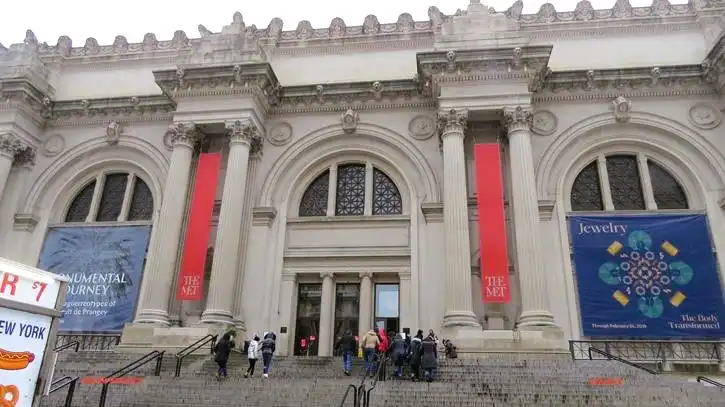
First, we would like to express our sincere gratitude to this Museum. We are immensely grateful for the unique cultural value that its impressive collection offers to all!
Yes, this place is undoubtedly fascinating and grand, and we have had the privilege of visiting it several times. It is a place where people from different parts of the world come together, and in each room you enter, you will surely find a new surprise. Thus, in this museum, we found not only this significant first piece of evidence but also several others. Although smaller in scale and meaning, these pieces of evidence are clear indications that, together, will certainly strengthen the legitimacy of our research, confirming this museum as one of the most remarkable.
And, as we mentioned about Egypt: everyone should, at least once in their life, experience this!
Now let's head straight to the hallway where our fantastic piece was displayed!
Photo credit: Our records - Metropolitan Museum - New York - USA - 2019.
Reference: The Metropolitan Museum of Art - MET (New York).
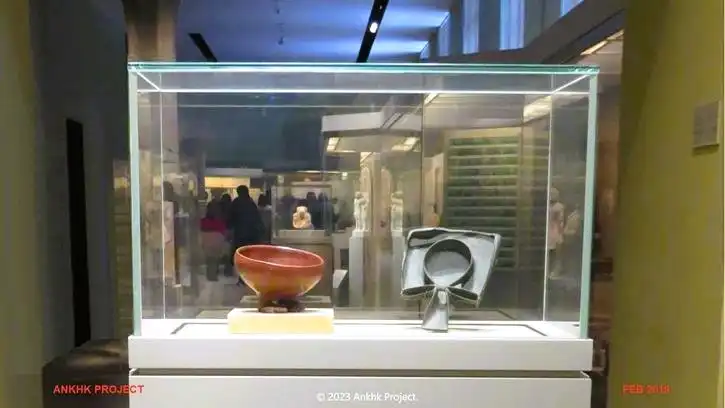
Yes, here is our "first piece of evidence", and now, in person!
We made this visit in February 2019, although, for our Timeline, we are discussing events from August 2013. With this image, we are simply illustrating the scenario personally experienced, years after the discovery of this evidence.
Now, look at this ritual vessel, beautiful and majestic, which, despite perhaps five (5) millennia having passed since its creation, is still remarkably preserved!
Yes... that moment, standing before this piece, was truly special. At that instant, we reflected on the fifteen (15) long years since our trip to Egypt, years spent trying to find a solution. And now, we were finally face to face with it.
Well, now let's reflect a little with a question, even though we won’t go into many details about this piece, its true use and meaning, which we have already mentioned as one of the most important ever found by archaeology. So, let's focus on it... exactly this piece (and you will understand why), exactly in this format (you will also understand), exactly from the first great reign of Egypt, exactly found and still preserved until our days, despite being fragile, and, for any reason, could easily have been broken and inevitably discarded. And then... what a tremendous coincidence, right? Everything in life has a good reason... believe it!
So, after finding these evidences from the Narmer period (remember we found two), almost at the end of August 2013, we started a new journey. And, in this way, we went directly to the Books of the Torah (Old Testament - Genesis), which we will explore next, allowing everyone to better understand various biblical points that are still the subject of debates and controversies. And, where, of course, we will find three (3) of our most impactful discoveries!
Photo credit: Our records - The Metropolitan Museum of Art - New York - USA - 2019 / Libation Dish Depicting Ka-Arms Presenting an Ankh-Sign, Rogers Fund, 1919 |19.2.16| - Public Domain. / Bowl with Human Feet, Rogers Fund, 1919 |10.176.113| - Public Domain.
Alright, clarifying the "new journey" mentioned above, regarding the end of August 2013.
Shortly after we found our two pieces of evidence (Step 47), we concluded that it would be interesting, based on the solution found for the "algorithm," to start a new search in ancient texts to try to identify the possible "origin of all this", of all this context below:
Yes, this "supposed origin", as we had theorized (although "still" not exposed here), could have occurred long before the Egyptians, long before even many civilizations. Therefore, our only path would be to search for the oldest possible text that addressed human history!
And this, without a doubt, would be the Biblical Old Testament, represented by the Book of Genesis, the only one that could, despite all its controversies, present us with the oldest known history of humanity, whether its passages are proven or not!
Now, please... pay close attention to this important point regarding the Biblical Book of Genesis in the Old Testament.
And more... we still have two (2) points of extreme importance about this biblical context...
Now, one last important point to leave no loose ends...
In our next step, we will fully present why our search for the "origin of everything" led us so far into our past!
References: Dead Sea Scrolls (Davies, Philip R.. "Dead Sea Scrolls". Encyclopedia Britannica, 25 Mar. 2025, https://www.britannica.com/topic/Dead-Sea-Scrolls. Accessed 29 March 2025.) / Dead Sea Scrolls (King, Justin. "Dead Sea Scrolls." World History Encyclopedia. World History Encyclopedia, 22 May 2012. Web. 27 Mar 2025.).
Therefore, let's check an important analogy between our "response to the algorithm" and our "oldest times"!