


9
Well, as we mentioned earlier...
Due to the great impact that our latest discoveries could certainly generate, we recognized the need to carry out, in equal measure, important and rigorous validations of the biblical passages. Therefore, we deepened our analyses of these texts to balance the proportion between discovering something significant and validating it conclusively.
However, it is important to emphasize that, upon reflecting on everything we had already accomplished, we realized that an essential part of this work had already been completed. What remained, of course, was the most challenging stage: conducting a second validation of the location of the "Biblical Garden of Eden." Thus, we clarify below our reasoning regarding what had already been, in a way, effectively resolved, versus what still needed to be done:
Still, in this validation equation, what was missing to close the cycle completely was precisely a second verification of the "Garden", just as we had done for the "Region".
It’s worth remembering that this entire validation process arose solely and exclusively from our need to confirm the content of the Biblical Book, in order to validate, as a consequence, the "complementary information" we extracted from it. These were insights that helped us identify, in other civilizations and historical periods, the same Egyptian scenarios associated with the Ankh symbol and its supposed "lost" or "incomplete" translation, depending on how one chooses to interpret it.
So, focusing on this new need, the double validation of the "Garden", we had to begin a new literary investigation. Although, at the time, we already had a clear and substantial idea of its possible location, we turned to more ancient literature and, as a result:
Without a doubt, it was with immense satisfaction that we witnessed the fruits of years of effort and dedication finally being rewarded. We not only uncovered this "enigmatic Egyptian symbol", but also validated, by logical consequence (as will be thoroughly detailed in our Research Book), all of our previous discoveries, absolutely all of them! From our very first important observation in Egypt, which originated the "complex algorithm" among the hieroglyphs, to our most recent discoveries linked solely to the Biblical Book, ultimately culminating in the Great Sphinx of Giza as a symbolic link connecting all these scenarios. As we said at the beginning of our journey... it all became a great "domino effect"!
And so, a new and intriguing question emerged: now that we had additional information beyond the biblical lines, and drawn from various other sources of knowledge, "who" or "what" allowed us to arrive at this revelation about the Sphinx, connecting it with everything we had discovered, even when not everything was directly related to Egypt, but rather to the Biblical Book, as in the case of the "Region of Eden" and its "Garden", while the discovery of the "Algorithm" related exclusively to Egypt and other civilizations we were clearly able to observe?
Remember when we mentioned his name as a major reference at the beginning of our journey (Step 8)? Well, that’s exactly why!
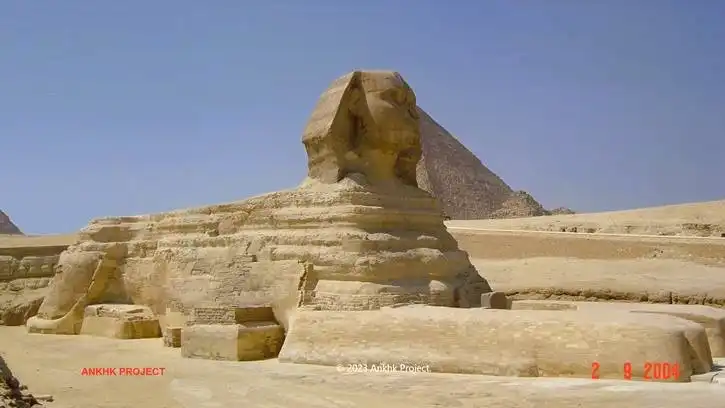
And so, we move on to the next step, seeking to understand what he left us, something that led us to this new and extraordinary discovery. In this next phase, we will present our fourth set of "locked contents", now related to the Great Sphinx of Giza.
Photo credit: Our records - Sphinx of Giza - Cairo - Egypt - 2004.
References: Imhotep (Britannica, The Editors of Encyclopaedia. "Imhotep". Encyclopedia Britannica,
01 Mar. 2023, https://www.britannica.com/biography/Imhotep. Accessed 8 July 2023.) / Imhotep (Mark, Joshua J.. "Imhotep."
World History Encyclopedia. World History Encyclopedia, 16 Feb 2016. Web. 08 Jul 2023.).
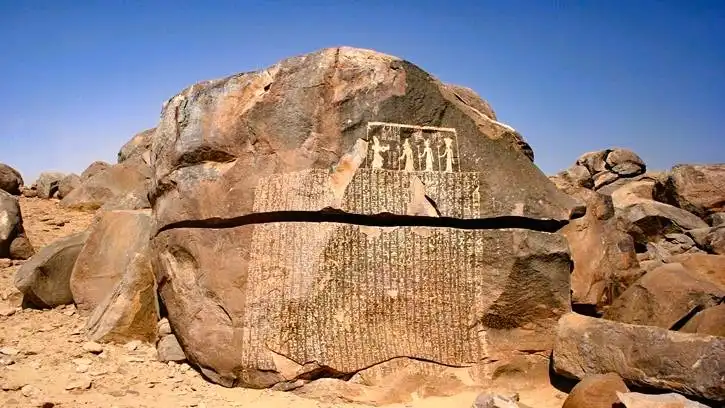
Very well, here is the "Famine Stela" of Djoser...
Written in Egyptian hieroglyphs during the Ptolemaic Dynasty (332–30 BCE), and located on Sehel Island in the Nile River, near Aswan, this inscription describes a time when the Egyptian people, under the reign of Pharaoh Djoser (Third Dynasty – 2670 BCE), endured seven (7) years of severe drought and famine.
Undoubtedly, this was something extremely significant. But we knew, as with any discovery, great or small, that something even more complex and perhaps far greater would likely follow. That, however, is for the next step. For now, let’s explore a bit more about the content engraved in this stone.
To summarize the context in a more accessible way, even without direct support from our “Research Book,” we can draw a parallel with the Rosetta Stone (link at the end), also found in Egypt, which allowed for the decoding of Egyptian hieroglyphic writing. In this case, though slightly different, the "Famine Stela" offered us crucial elements to compose a scene of convergence with everything we had already discovered. It presented us with connections between the Sphinx and our Algorithm, which, in turn, relates to the complementary information drawn from the Bible. When validated, this led us to the "Region of Eden" and its emblematic "Garden."
Do you see how everything began to fit together in a coherent and complementary way?
Of course, we understand that this coherence is, for now, only visible from our perspective, since at this stage, the reader still does not have access to all the information gathered in our Book. Still, it's possible to grasp how these connections make sense, and how this link between the Sphinx and everything we’ve uncovered carries a unique and powerful dose of understanding and truth.
Exactly, reader... if we were to reveal right now what this link is that unites the Sphinx to everything and everyone, not just to our discoveries, believe us: this work, currently available on the Internet, would “go offline” within minutes. Moreover, such an action would completely go against our own sense of responsibility and awareness, because any revelation of this magnitude requires proper preparation. Otherwise, it could trigger unpredictable reactions among parts of the population who, clearly, are not to blame for their misunderstanding. These are simply people who may need more time to process that parts of what they’ve always been taught may not be entirely accurate... not out of malice or deliberate intention, but purely due to a lack of knowledge, knowledge that only now has become accessible to us. And most importantly, that these same people come to understand that yes, there is still something more, something beyond, that remains among us even to this day. Very difficult!
Nevertheless, once again, in honoring our important commitment to you reader, at the end of this step, another set of "locked content" will be revealed, containing valuable clues for those who’ve stayed with us thus far. Now, once more, you will have the chance to see more clearly what this journey is truly about. So yes, we are talking about the discovery of the great secret of the "Sphinx of Giza". And, as stated in our Step 1 ("Before starting your journey"), you already know what to do!
PROTECTED CONTENT !
Photo credit: Morburre,
CC BY-SA 3.0, via Wikimedia Commons.
References: Djoser - Famine Stele (Mark, Joshua J.. "Djoser." World History Encyclopedia.
World History Encyclopedia, 12 Feb 2016. Web. 08 Jul 2023.). / Rosetta Stone (The Editors of Encyclopaedia Britannica. "Rosetta Stone".
Encyclopedia Britannica, 25 Apr. 2025. Accessed 30 April 2025.). /
Rosetta Stone (Cartwright, Mark. "Rosetta Stone." World History Encyclopedia. World History Encyclopedia, 03 Jan 2014. Web. 30 Apr 2025.).
Yes, it would certainly be the Biblical Book, because even though we associated both the "Region of Eden" and its "Garden" as elements validating its passages, there was still something more conclusive missing before we could state that it was properly validated, at least with regard to the Book of Genesis, a fundamental part of the Torah!
Yes, this was still undeniably, whether we liked it or not, a profound truth and a major challenge!
Because even though we already had four (4) extraordinary revelations, two (2) biblical, one (1) non-biblical, and of course, our answer to the "algorithm", we still lacked what we considered essential: "numbers". And from our perspective, numbers are crucial, as they allow us to support solid reasoning and build realistic projections about dates, possible ages, time spans, and more. With more precise technical data in hand, we could then, by simple conclusion, validate the Biblical Book more conclusively.
Therefore, guided by this clear premise, the search for “numbers”, we returned to the Old Testament, our main focus, seeking something that would provide the numerical answers we needed. And that’s how we arrived at the accounts of Noah’s Flood, a biblically significant event, notable for its narrative structure rich in "temporal" information, that is, elapsed time. However, it had never been studied with the depth and additional data we had gathered over these intense years of research.
Thus, aiming to gather evidence of both its real occurrence and as another validation mechanism, we chose to deepen our studies on these key biblical events. And if we were to find positive results, we could conclude that the Book of Genesis, in particular, was indeed properly validated, thereby also legitimizing all that we had previously discovered based on its passages, which had provided us with valuable complementary information.
Yes, it was a long and exhausting task, as it couldn’t have been otherwise. Yet, once again...
OK, let’s go ahead, and without delay, uncover these new revelations in the next stage!
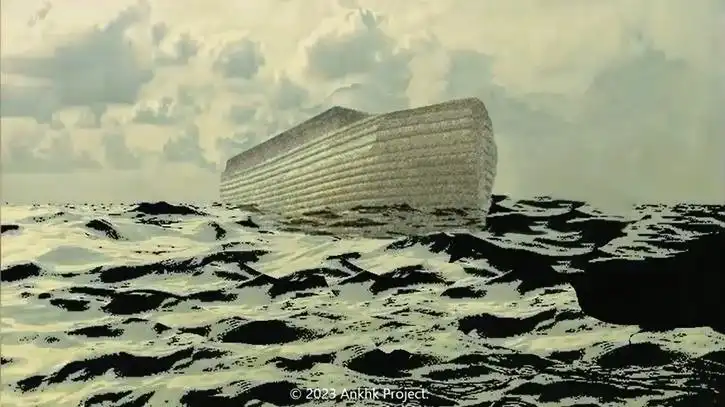
And... using just one (1) of our three (3) keys found between the biblical lines, we discovered revealing technical details about this possible event, conclusively confirming our four (4) important previous discoveries, as well as the passages of the Old Testament itself. Let's go through them:
In addition to these, other equally relevant details are documented in our “Research Book”. There, we developed a segmented timeline covering all phases of this extraordinary flood, step by step, day by day, event by event, from the location of the Ark's construction to its final destination. But beware: do not confuse "final destination" with "final result", as these are entirely different concepts. And about that destination... perhaps we can reveal a bit more: it’s not exactly close, but also not too far from Göbekli Tepe.
Now, honoring here our important commitment to you, at the end of this step, another set of "locked content" will be revealed, with valuable clues for those who have stayed with us so far. Now, we begin to see more clearly what this journey is truly about. So let us delve into the famous "Flood of Noah". And notice: just like in the previous "locked contents", a lot is being revealed in these verses. Observe their nuances, the positioning of each line... for even without us stating it directly, there is much being communicated, if you know what we mean! And, as stated in our Step 1 ("Before starting your journey"), you already know what to do!
PROTECTED CONTENT !
Image Credit: Our records - Featured illustration.